
Information im Zentrum der Wissenschaft, Wirtschaft und Gesellschaft
In allen Bereichen der Wirtschaft und Gesellschaft spielen Information eine zentrale Rolle: Wir sind von einer zunehmenden Anzahl intelligenter technischer Informationssysteme umgeben, die mit Fähigkeiten wie Interaktion, Umweltbewusstsein und Selbstanpassung ausgestattet sind.
Das KIT Center Information · Systems · Technologies (KCIST) untersucht und entwirft komplexe adaptive technische Systeme für einen sicheren und effizienten Umgang mit Informationen, basierend auf Kompetenzen wie Algorithmus, Software-Engineering, Cloud Computing und wissenschaftliches Computing, sicheren Kommunikationssystemen und Big Data Technologien sowie intuitive Mensch-Maschine-Schnittstellen, menschenzentrierte Robotik, Industrierobotik und Automatisierung. Daher bündelt es interdisziplinäre Kompetenzen in allen KIT-Abteilungen, insbesondere aus den Bereichen Informatik, Wirtschaft, Elektrotechnik und Maschinenbau, Informationstechnologie sowie Sozialwissenschaften. Das Hauptziel des Zentrums ist die Förderung von Forschung und Innovation sowie des Technologietransfers zwischen dem KIT und seinen Partnern in Wissenschaft und Industrie auf nationaler und internationaler Ebene.
From September 14 to 18, 2026, KIT hosted the 19th Machine Translation Marathon, organized in cooperation with the European Association for Machine Translation (EAMT). The week long gathering brought together machine translation researchers, developers, students and users from around the world for keynote talks, tutorials, a poster session and collaborative project work in small teams. Keynote speakers from Meta FAIR, Google DeepMind, Apple, Cohere, Aleph Alpha Research, Fondazione Bruno Kessler, Charles University, Johannes Gutenberg University Mainz and KIT covered topics from multilingual and multimodal foundation models and speech translation to machine translation for low resource languages. On Wednesday evening, the MT Marathon and the AiMat Summer School "Machine Learning for Molecules" held the joint public panel discussion "Large Language Models in Science - Hype or Future?". Recordings of the keynotes are available on the event website.
Machine Translation Marathon 2026
From September 14 to 18, 2026, the AiMat group of KIT hosted its fourth Summer School "Machine Learning for Molecules" in Karlsruhe, with support by the KIT centers MaTeLiS and KCIST. Aimed at undergraduate and early PhD students in informatics, chemistry and materials science, the program covered molecular property prediction, self driving labs, graph neural networks, ML potentials, and generative models and LLMs. Eight lecturers from institutions including the University of British Columbia, Carnegie Mellon University, Chalmers University of Technology, Merck and IBM Research gave lectures, complemented by hands-on tutorials, a lab visit and a poster session. The side program included a guided tour of the ZKM Center for Art and Media Karlsruhe, a social dinner and the public panel discussion "Large Language Models in Science - Hype or Future?", held jointly with the Machine Translation Marathon.
Summer School Machine Learning for Molecules
16.09.2026
On September 16, 2026, the podium discussion "Large Language Models in Science - Hype or Future?" took place from 19:00 to 20:30 at the Triangel am Kronenplatz in Karlsruhe, as part of the AiMat Summer School "Machine Learning for Molecules" and the Machine Translation Marathon, with support by KCIST. Large language models such as ChatGPT, Gemini and DeepSeek are becoming part of how research is done. The panel discussed whether they will have a lasting impact on science or whether expectations are exaggerated, and to what extent LLMs influence, accelerate or even drive scientific progress. Prof. Dr. Moritz Kreysing (KIT, Agents for Science), Dr. Celso Caldeira Rêgo (KIT, LLMs for Simulation Workflows) and Maike Züfle (KIT, AI for Language Technologies) gave presentations and discussed these questions, moderated by Prof. Dr. Pascal Friederich (KIT, AI for Materials Science). The evening ended with an informal get-together with the audience.
Summer School Machine Learning for Molecules
On September 9, 2026, the Innovation Campus Cyber Valley celebrated its tenth anniversary in Tübingen, where KIT presented the humanoid assistive robot ARMAR-7. Minister-President of Baden-Württemberg Cem Özdemir opened the event and, together with KIT President Prof. Jan S. Hesthaven and Vice President Prof. Oliver Kraft, learned about current research at the High Performance Humanoid Technologies (H²T) lab of KIT. ARMAR-7 also handed the Minister-President a pretzel. The humanoid robot series ARMAR is developed at KIT to support people in care and everyday life. ARMAR-7 understands natural language, grasps objects, assesses situations, plans ahead and continuously learns from interaction with humans and from its own experience. Prof. Tamim Asfour, head of H²T at the Institute for Anthropomatics and Robotics, KCIST spokesperson and spokesperson of the Robotics Institute Germany, took part in the discussion format "Cyber Valley Voices" and presented current research in the exhibition area.
Link to Press Release
ARMAR-7 at the European Parliament
On September 2, 2026, the European robotics network euROBIN presented 15 AI-based robot systems live in the European Parliament in Brussels. The demonstration was led by the German Aerospace Center (DLR) and hosted by Member of the European Parliament Axel Voss. It covered three scenarios of particular economic and societal relevance: robot-assisted manufacturing for a circular economy, personal robots for quality of life and well-being, and outdoor robots for sustainable communities. KIT took part with the humanoid robot ARMAR-7. Together with three other robots, ARMAR-7 cleared a breakfast table: the robots autonomously recognized the objects, grasped plates as carefully as the cereal box, put everything into the dishwasher, cupboard and fridge, and disposed of the waste. ARMAR-7 is equipped with a cognitive architecture with an episodic memory to store, recall and share its experiences. A closed round table with leaders from politics, industry and research discussed how AI-based robotics can grow into a European industry comparable in size and importance to today's automotive industry within ten to fifteen years.
Link to External News Entry
In the newest episode of the KIT video series "AI Experts", Pascal Friederich presents how artificial intelligence is increasingly becoming the fourth pillar of science alongside experimentation, theory, and simulation. AI can help scientists conduct experiments more quickly and efficiently, speed up simulations, or identify patterns in data that would otherwise be difficult to detect. Pascal Friederich leads the Artificial Intelligence for Materials Sciences (AiMat) group at KIT. Together with his team, he is pushing the development of AI and machine learning methods specifically for applications in materials science and chemistry. The "AI Experts" series features leading AI researchers from KIT. Each episode highlights cutting edge work in artificial intelligence, including machine learning, robotics, computer vision, language models, and human-centered AI.
Link to the VideoFrom August 4 to 6, 2026, three internationally renowned robotics researchers will give talks at KIT as part of the RimA Summer School "Towards Walking Robots in Domestic Environments", each from 13:00 to 14:30 in the Atrium of KIT InformatiKOM I (Building 50.19, Adenauerring 12, 76131 Karlsruhe). The talks are open to the broader robotics community in Karlsruhe. On Tuesday, August 4, Prof. Dr. Sven Behnke (University of Bonn) will speak on "Structured Perception, Planning, and Learning for Cognitive Service Robots", presenting methods for learning structured representations that enable service robots to generalize to novel situations. On Wednesday, August 5, Dr. Philip Arm (Flexion Robotics AG, Zurich) will present "Legged Robots – From Quadrupeds in Space to Humanoids in Industry", following the journey of legged robots from planetary exploration research to humanoid systems for industrial applications. On Thursday, August 6, TT-Prof. Dr. Barbara Bruno (KIT) will talk about "Walking Among Us: Socially-aware Navigation for Everyday Robots", discussing how robots can navigate public and domestic spaces in socially acceptable ways.
Link_more
From August 3 to 7, 2026, the transfer center RimA: Anlaufstelle für Robotik im Alltag will host the Summer School "Towards Walking Robots in Domestic Environments" in Karlsruhe with support by KCIST. The event is organized by the FZI Research Center for Information Technology in cooperation with KIT and brings together international PhD and Master's students selected from almost 450 applications. Participants work in small groups on software challenges in Python and C++ with ROS 2, each addressing a typical domestic problem such as clothes and shoes as obstacles on the floor. They integrate and evaluate their solutions directly on the walking robots Unitree Go2 and Boston Dynamics Spot for navigation, perception, and manipulation tasks. The week concludes with a competition in which each group presents its approach on a course modeled after a typical home environment. RimA connects actors from research and industry with the institutions and people who use assistance and service robotics in daily life. The consortium consists of FZI, KIT, Freie Universität Berlin, the University of Bonn, and TÜV SÜD.
RimA Summer School 2026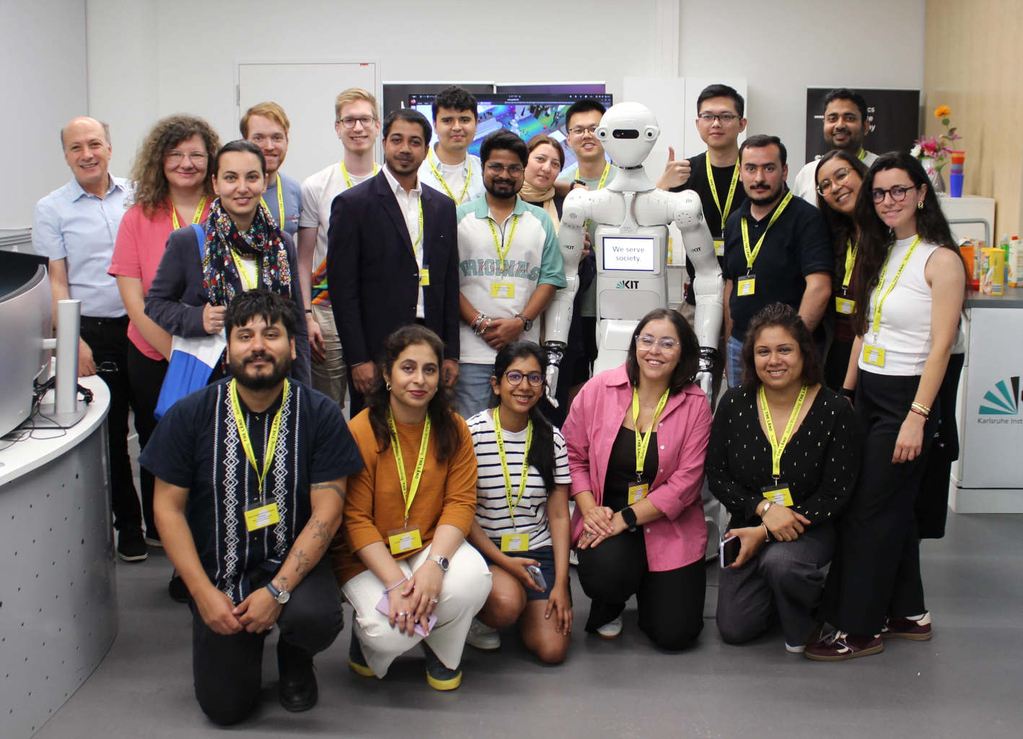
On 8 July 2026, 18 early-career researchers working on AI in the life sciences, materials science, biosensing and imaging from 14 countries visited KIT as part of the follow-up trip to the 75th Lindau Nobel Laureate Meeting, under the theme "AI Research across Disciplines in Baden-Württemberg". After an introduction to KIT's research landscape at InformatiKOM I by Prof. Tamim Asfour, the group toured the High Performance Humanoid Technologies (H²T) lab followed by a talk by Prof. Patrick Théato on the Cluster of Excellence POLiS – Post Lithium Storage. The afternoon on Campus North covered KIT's HELMA Self-Driving Laboratories which were presented by Prof. Ute Schepers at the ZEISS Innovation Hub and the KATRIN neutrino experiment together with the Tritium Laboratory Karlsruhe, presented by Dr. Magnus Schlösser.

At Hannover Messe 2026, the Karlsruhe Institute of Technology (KIT) is presenting the humanoid robot ARMAR-7, developed at the Institute for Anthropomatics and Robotics (IAR). Designed for human-made environments such as households and care facilities, ARMAR-7 combines speech-based interaction, gesture understanding, and autonomous task execution to support everyday activities. The system builds on the latest version of the self-developed cognitive robot software architecture ArmarX, enabling it to learn new tasks from human demonstration and adapt to user routines. ARMAR-7 can perform activities such as unloading a dishwasher, sorting laundry, and organizing kitchen items. The presentation at Hannover Messe highlights ongoing progress at KIT toward flexible and safe humanoid assistance systems for future real-world use.
Further details, including a short video, can be found in the original SWR feature which is linked below.
SWR Press Release (German)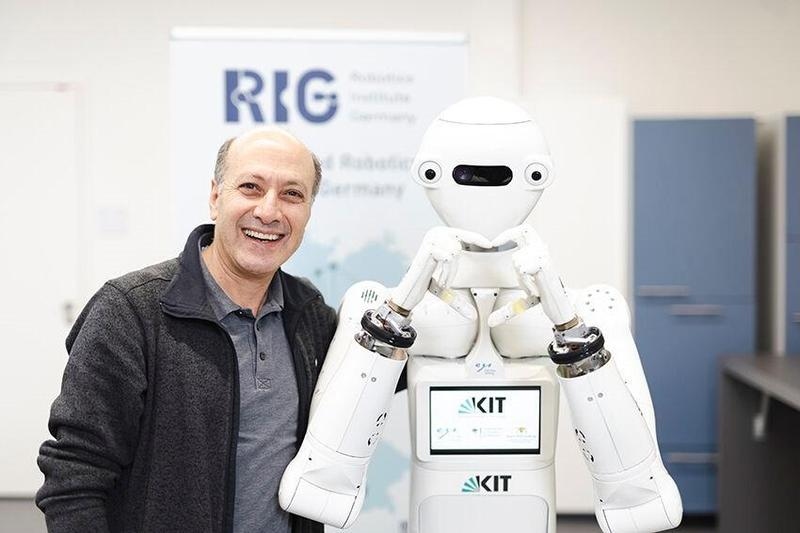
On 30 April 2026, the Karlsruhe Public Library in the New Ständehaus, in cooperation with KIT, will host a public talk by Prof. Tamim Asfour titled “Artificial Intelligence in Humanoid Robots: What Lies Ahead and What Can We Shape?”. The event will take place from 17:00 to 18:00 and offers an accessible perspective on current developments in humanoid robotics and embodied artificial intelligence. The talk addresses how humanoid robots can grasp, walk, interact, and learn, and considers what these technological advances may mean for everyday life and society more broadly.
Further information
HERON Guest Talks
Prof. Petros Maragos, Prof. Evangelos Papadopoulos,
and Prof. Costas Tzafestas
01.04.2026
On 1 April 2026 at 16:00, the HERON-RIG-KCIST Colloquium will feature guest talks by Prof. Petros Maragos, Prof. Evangelos Papadopoulos, and Prof. Costas Tzafestas, who are visiting in connection with the HERON project. HERON, the Hellenic Robotics Center of Excellence, is funded under the European Union’s Horizon Europe Widening Programme (Teaming for Excellence) and aims to establish the first Robotics Center of Excellence in Greece for advancing robotics in the AI era. The initiative is being developed jointly by Athena Research Center, Greek university partners, the Italian Institute of Technology, and KIT.
Further information
Towards Scalable Robot Intelligence:
The Interplay between Planning and Learning
27.03.2026
David Hsu, Provost’s Chair Professor of Computer Science at the National University of Singapore and director of both the Smart Systems Institute and the NUS Artificial Intelligence Laboratory, will speak on the integration of model-based planning and data-driven learning for robust robot intelligence. His talk examines how robot foundation models extend robotic capabilities in unfamiliar, open-world settings, while arguing that scalable performance requires a principled interplay between structure and data. Drawing on recent work, he will discuss robots that navigate diverse environments, fold varied clothing, and operate in open-world scenarios through hypothesis generation and verification.
Link_moreThe state of Baden-Württemberg is investing 2.4 million euros over three years to expand ACCESS@KIT into a statewide service center for students with visual impairments. Central to the expansion is "IncluDocs BW", a new AI-based platform that transforms lecture materials into accessible formats. The project draws on KCIST expertise in artificial intelligence and adds to a growing portfolio of AI-driven accessibility tools at KIT, such as the Lecture Translator for automatic interpreting. ACCESS@KIT is led by Professor Rainer Stiefelhagen, who heads the chair "Computer Science for the Visually Impaired" at the Institute for Anthropomatics and Robotics (IAR). The work builds directly on research pursued within the graduate school KATE (Accessibility through AI-based Assistive Technology), of which Professor Stiefelhagen is the spokesperson.
Link_more
Am 03. Februar 2026 gab Prof. Sami Haddadin, Mohamed bin Zayed University of Artificial Intelligence, Abu Dhabi einen online-Vortrag im Rahmen der RIG-KCIST Vorlesungsreihe.
Weitere Informationen
20.01.2026
Prof. Dr. Andreas Kugi, Wissenschaftlicher Direktor am Austrian Institute of Technology und Professor für komplexe dynamische Systeme an der Technischen Universität Wien (TU Wien) hielt am 20. Januar 2026 um 17:30Uhr einen Vortrag im vollbesetzten Atrium des InformatiKOM I, KIT.
Weitere Informationen
20.01.2026
Am 13. Januar 2026 besuchte der Geschäftsführer des Cyber Valley Dr. Florian K. Mayer das KIT. Neben einer ausführlichen Laborführung mit Demos im Labor „Hochperformante Humanoide Technologien (H²T)“ durch dessen Leiter Prof. Dr. Tamim Asfour, wurden vertiefende Gespräche mit dem Präsidenten des KIT, Prof. Dr. Jan S. Hesthaven sowie den Vizepräsidenten Prof. Dr. Thomas Hirth, Vizepräsident Transfer & Internationales und Prof. Dr. Oliver Kraft, Vizepräsident Forschung, Lehre und Akademische Angelegenheiten am KIT, geführt.
Weitere Informationen
Der Vorstand des IEEE ernannte Prof. Dr. Tamim Asfour mit Wirkung zum 1. Januar 2026 zum IEEE Fellow für seine Beiträge zur humanoiden Mechatronik und kognitiven humanoiden Robotik.
Weitere Informationen
09.12.2025
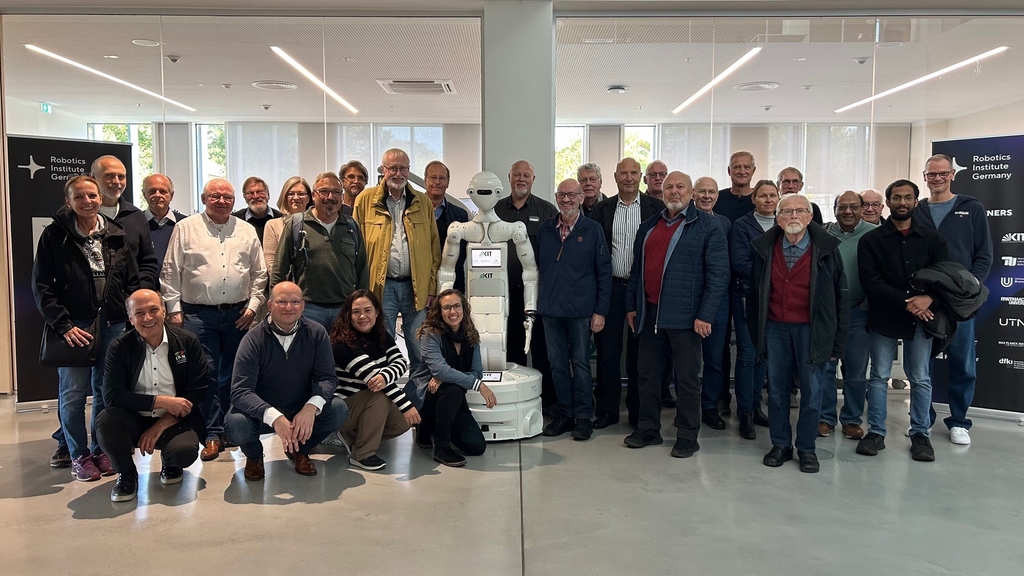
Das erste RIG-Bootcamp zu grundlegenden Verhaltensmodellen fand vom 24. bis 28. November 2025 am KIT statt und brachte 16 Doktoranden aus 11 deutschen Universitäten zu einer intensiven Woche gemeinsamer Forschung zusammen. Da grundlegende Verhaltensmodelle die Robotiklandschaft durch weltweite Investitionen in Milliardenhöhe neu gestalten, ist eine koordinierte Zusammenarbeit zwischen deutschen Forschungseinrichtungen unerlässlich geworden, um in diesem sich schnell entwickelnden Bereich wettbewerbsfähig zu bleiben. Das Bootcamp stellte sich dieser Herausforderung, indem es einen Raum schuf, in dem Forscher ihre kollektiven Stärken nutzen konnten.
14.09.2025
Was passiert, wenn KI wirklich im Dienste der Menschheit steht? Knapp 40 Leserinnen und Leser Deutschlands führender Wissenschaftsverlag „Spektrum der Wissenschaft“ besuchten das KIT, um dieser spannenden Frage nachzugehen. KIT-Professorinnen und Professoren stellten ihre bahnbrechenden Forschungsarbeiten vor, bei denen der Mensch im Mittelpunkt der künstlichen Intelligenz steht. Die Besucherinnen und Besucher erlebten Live-Demonstrationen von humanoiden Robotern, die durch Beobachtung von Menschen lernen, entdeckten, wie KI Technologie für alle zugänglicher machen kann, und erfuhren, wie künstliche Intelligenz die Sprachverarbeitung und die Materialforschung revolutioniert.
Weitere Informationen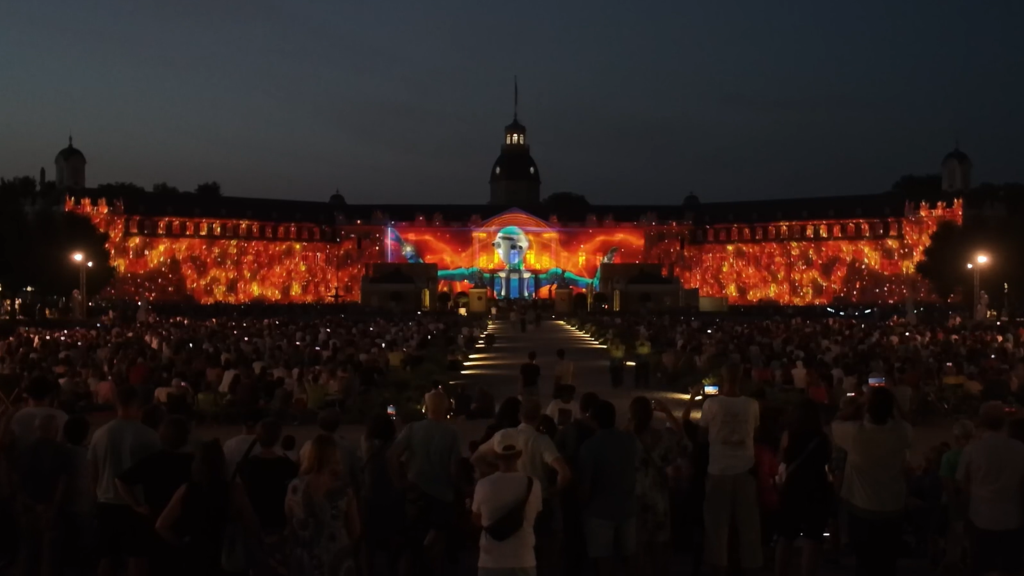
14.08.2025
Der zehnminütige Filmbeitrag mit dem Titel „Science for Impact“ gestaltete die spanische Künstlergruppe Los Romeras, die schon mehrmals bei den Schlosslichtspielen ihre Arbeit zeigte. Der Beitrag vermittelt auf künstlerische Art und Weise, wie vielfältig die Wissenschaft am KIT ist, und soll die Neugier für unsere Forschung wecken.
Die visuelle Vielfalt des Films ergibt sich aus den Themen folgender KIT-Zentren, die ihn finanziert haben: Energie, Klima und Umwelt, Informationen · Systeme · Technologien, Elementarteilchen- und Astroteilchenphysik, Gesundheitstechnologien, Materialien in Technik und Lebenswissenschaften, Mobilitätssysteme sowie Mensch und Technik.
Weitere Informationen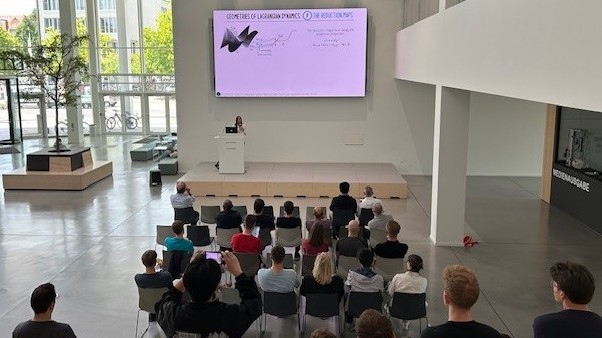
31.07.2025
Asst. Prof. Dr. Noémie Jaquier, KTH Royal Institute of Technology, Schweden, hielt am Dienstag, den 29. Juli 2025, um 13:00 Uhr im Atrium des InformatiKOM I, Bldg. 50.19, Adenauerring 12, einen Vortrag zum Thema "The geometries of Lagrangian dynamics".
Weitere Informationen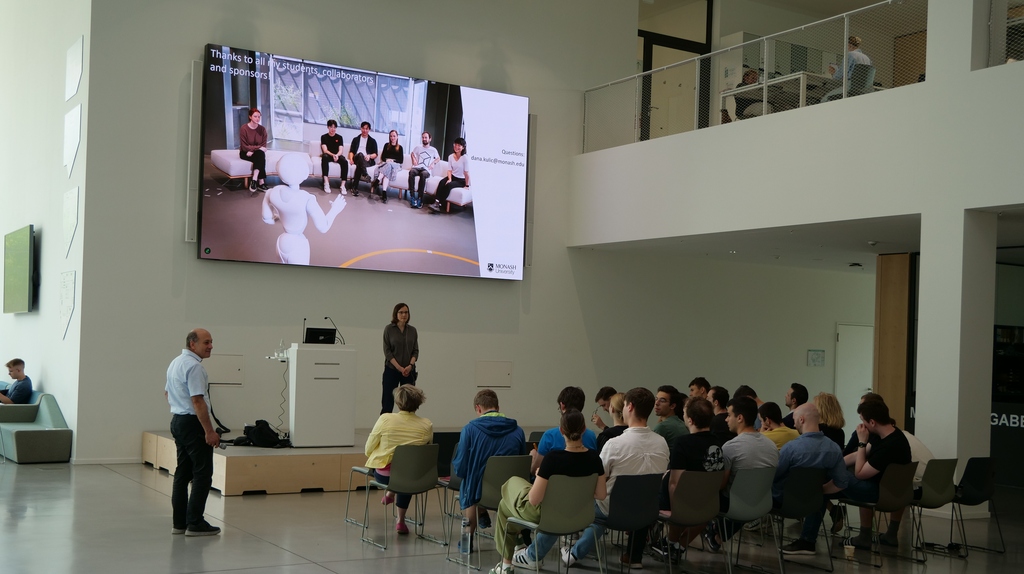
14.07.2025
Prof. Dana Kulić, Monash University, Australia, hielt am Freitag, den 11. Juli 2025, um 13:00 Uhr im Atrium des InformatiKOM I, Gebäude 50.19, Adenauerring 12, einen Vortrag zum Thema "Effective Human Robot Teaming".
Weitere Informationen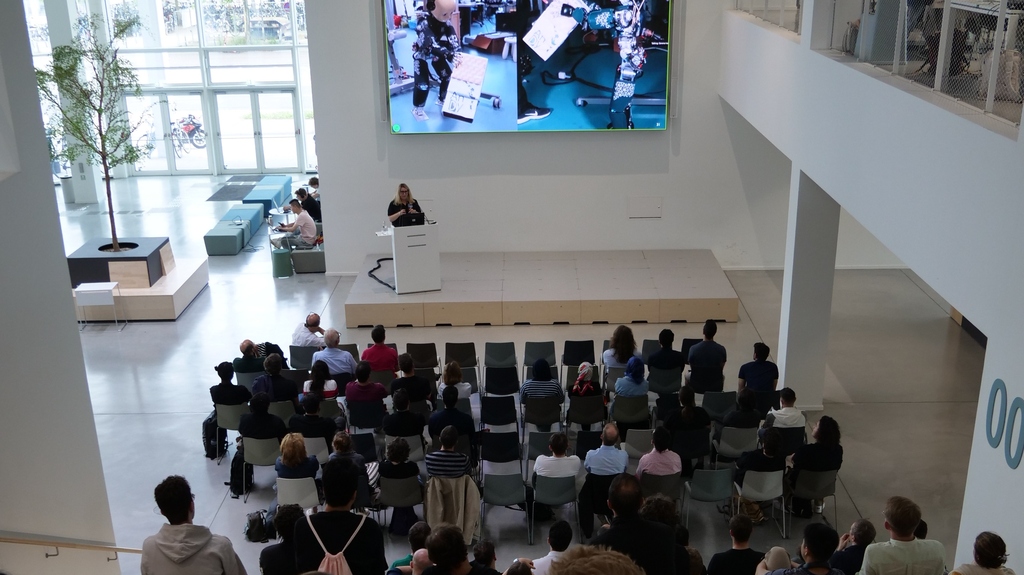
14.07.2025
Prof. Dr. Serena Ivaldi, Inria center of the University of Lorraine, hielt am Mittwoch, den 9. Juli 2025 um 11:00 Uhr im Atrium des InformatiKOM I, Gebäude 50.19, Adenauerring 12 den Vortrag "The new Human Centered Robotics team at Inria Nancy: from humanoids to exoskeletons" .
Weitere Informationen